
Articles

The preservation of food has been one of the most important needs of humans since the advent of settled life. In human history, during the era of hunting and gathering, food was consumed before it could spoil, but after the transition to agricultural production, it became necessary to preserve products between two harvest periods. Similarly, meat, fish, and dairy products also need to be stored for a certain period.
In ancient times, methods such as storing in cold caves, salting, smoking, burying, cooking, drying, and canning were used to preserve food through trial and error. This ensured that food was preserved until it could be consumed. Today, the cold chain is utilized to meet this need.
The main causes of food spoilage are microorganisms, enzymes, temperature, and light. When microorganisms find favorable conditions on food, they rapidly consume nutrients and turn what should be a beneficial food into something harmful. The cold chain is a system cycle that prevents the chemical, biological, and microbiological effects that can result from food spoilage. In short, it is the path from the producer to the consumer's table. It is also one of the most important components of food safety. To ensure food safety, the cold chain must not be broken during storage, packaging, shipping, and display stages.
To summarize the cold chain in a simple diagram, it is as follows:

Pre-cooling is the process of gradually lowering the core temperature of fruits and vegetables harvested from the field to the storage temperature. Post-harvest pre-cooling prevents the growth of microorganisms, thereby extending the storage life and preventing the deterioration of their appearance. After pre-cooling, some products are directly marketed, while others are placed in cold storage. Products placed in cold storage without pre-cooling can alter the temperature of the existing products in storage, compromising their integrity. Pre-cooling methods include forced air pre-cooling, hydro-cooling, pre-cooling with snow or flake ice, and vacuum pre-cooling. The choice of method depends on the product to be cooled.
Quick Freezing (shock freezing) is the rapid lowering of the temperature of products. Shock freezing is mandatory for products to be stored at -18˚C. Some products pre-cooled to 0-5˚C are taken to shock freezing rooms, also known as freezing tunnels, where their core temperature is brought down to -18˚C before being placed in frozen storage. Shock freezing methods include forced air shock freezing, plate freezers, and brine shock freezing.
Products placed in storage rooms after pre-cooling and shock freezing are preserved there until their next consumption time, becoming more valuable in the market. Various methods are used today for food preservation. Among these, the most important is cold storage, which we use in almost every field today. Cold storage rooms, where the growth and activity of microorganisms in food are prevented by low temperatures, can be divided into two main categories. The first is cold storage rooms for products consumed in a short time, generally for fruits and vegetables, and the second is frozen storage rooms for long-term storage, generally for meat and dairy products.
Cold storage rooms are places where products are stored at 0°C or a few degrees higher. Since the storage temperature varies depending on the product, it is not correct to provide a fixed temperature value. In addition to temperature, humidity also plays an important role in cold storage. Thus, each product has different temperature, humidity, and shelf life requirements. Therefore, the capacity and size of the cooling machine and installation to be installed in the cold storage room vary depending on the product being stored.
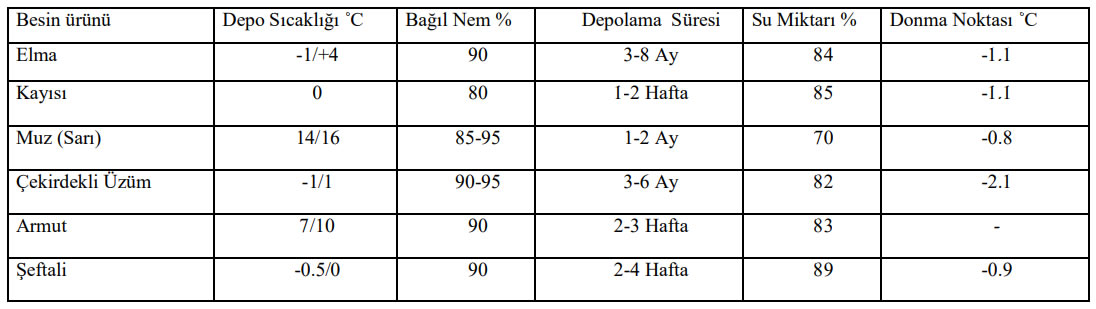
Frozen storage is the storage of products taken from shock freezing rooms at -18°C and below. Fruits and vegetables contain freezable water, and turning this water into ice reduces the water activity in the products. Along with the reduction of water activity, lowering the temperature also reduces the rate of chemical and biochemical reactions as well as microbial activities. As with cold storage, the temperature and humidity in frozen storage also vary according to the product.
Products placed in frozen storage rooms are stored in small packages ready for direct sale or in large boxes to be packaged later. Products can be stored at heights exceeding their length with the help of special shelving systems or pallets. When it is time for the products to be consumed, they are taken from storage rooms and moved to processing areas at 12˚C, where sorting and packaging processes are carried out.
After the packaging processes are completed, the products are loaded onto refrigerated vehicles and sent to the consumption area. Insulation of different thicknesses and different vehicle air conditioning systems are used in refrigerated vehicles according to the storage temperature to ensure that products are transported at the appropriate temperature. While special fan cooling systems are used for +4˚C and -18˚C refrigerated vehicles, eutectic plates with a charging method are used for -25˚C vehicles. These vehicles are mostly used for ice cream distribution. Refrigerated vehicles are not for cooling the product but for transporting it at the storage temperature. Products transported by refrigerated vehicles are placed in display refrigerators or deep freezers, where they await the day they will reach the final consumer's refrigerators without breaking the cold chain.